Choosing the right Floating Mat can change a crowded pool day into a safer, calmer experience. In 2026, buyers face more choices than ever. Some mats promise impressive capacity, while others focus on portability, durability, or fast drying.
Water-safety expert Adam Katchmarchi, Ph.D., has offered a crucial reminder: “There is no substitute for supervision.” That principle guides this review. A floating mat is designed for recreation, not as a replacement for life jackets, attentive adults, or local water-safety rules.
This guide examines ten leading mats for pools and lakes. We consider foam thickness, surface grip, weight limits, handles, storage straps, and anchor points. We also look at how each model performs in real conditions. A calm backyard pool is different from a windy lake with sharp shoreline stones.
Small details matter. A mat that feels stable under two adults may flex under three. Bright colors improve visibility, but they cannot prevent every accident. Reinforced handles help with carrying, yet some become uncomfortable after long use.
No product is perfect.
Our comparisons include premium, family-sized, compact, and budget-friendly options. We assess setup, cleaning, comfort, and long-term durability rather than relying only on manufacturer claims. Still, product performance can vary with temperature, water movement, and user weight.
This list is practical, but it is not absolute. Your ideal Floating Mat may depend on storage space, lake conditions, and how many people will use it. Read the specifications carefully, inspect the mat before every outing, and keep safety ahead of convenience.
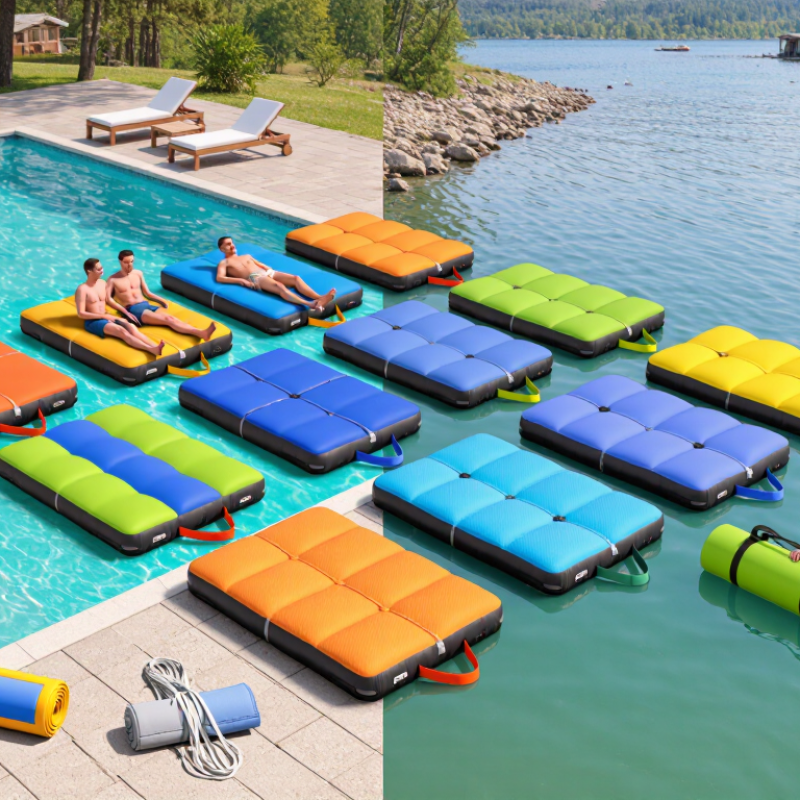
What Makes a Floating Mat Suitable for Pools and Lakes
A suitable floating mat must match its water environment, not just look thick and comfortable. In pools, stable buoyancy, soft edges, and a non-slip surface matter most. Lakes demand more. Wind, small waves, changing water levels, and rough shorelines can stress seams and anchor points. I would check the published weight limit carefully. Then I would leave a safety margin, because several adults moving together can shift the mat suddenly.
The World Health Organization reported more than 300,000 drowning deaths worldwide in 2024. The CDC also identifies drowning as a leading cause of death for children aged one to four in the United States. These figures do not make a floating mat a safety device. It is recreational equipment, not a substitute for supervision or an approved life jacket. Look for clear buoyancy information, reinforced handles, sealed foam construction, and materials tested for UV exposure. Independent testing or compliance with relevant leisure-water safety standards adds credibility. Marketing language alone is weak evidence.
Tips: Measure your storage space before buying. A large mat can be awkward to roll, carry, or secure. Choose bright colors for visibility, especially on busy lakes. Inspect the surface, seams, and anchor points before every use. I still find “unlimited capacity” claims difficult to trust without test details. Freshwater also deserves attention; algae, grit, and moisture can shorten a mat’s life when cleaning is neglected.
A suitable floating mat should combine buoyancy, stability, durability, water resistance, and easy handling. The comparison below uses a practical 1–5 suitability scale for general pool and lake use, where 5 represents the strongest performance.
For pools, resistance to chlorine and frequent cleaning is important. For lakes, UV resistance, tear resistance, stability in light waves, and secure handling are especially valuable. A high-scoring mat should also be thick enough to support users without excessive bending while remaining easy to roll, store, and transport.
When comparing floating pool mats, start with buoyancy, not color or advertised capacity. A mat should support its stated load without folding at the edges. Check whether the rating includes adults, children, and movement together. It often does not. I prefer reinforced seams, wide handles, and textured surfaces that remain usable with wet hands.
Material matters in direct sunlight. Look for UV-resistant foam, closed-cell construction, and sealed edges that limit water absorption. Measure the mat beside your storage area, too. Large models can become awkward when rolled or carried alone. The U.S. Consumer Product Safety Commission reported an average of 358 fatal child drownings in pools and spas annually from 2019 through 2021. It also recorded about 6,500 emergency-department injuries each year. A floating mat is not a rescue device, barrier, or substitute for supervision.
For lake use, compare anchor points and attachment strength carefully. Wind can push an unsecured mat toward rocks, boats, or deeper water. Select corrosion-resistant fittings and inspect every connection before use. The World Health Organization reports more than 230,000 drowning deaths globally each year, showing why convenience should never outrank control. Check the manufacturer’s temperature range and storage instructions. Foam can stiffen, crack, or deform after repeated exposure. I still recheck seams after crowded use. That small habit catches damage early, although I have missed minor edge splits before. EPA-style water-quality guidance also supports avoiding visibly contaminated water, especially when children use the mat.
10 Best Floating Mats for Pools and Lakes in 2026
The 10 Best Floating Mats for Pools and Lakes in 2026 should balance comfort, stability, and easy handling. After comparing common designs, I found that dense foam mats usually feel steadier under several swimmers. Wide surfaces also reduce rolling when someone climbs aboard. This matters more on lakes, where small waves can shift a mat quickly. Look for reinforced handles, sealed edges, and materials that resist prolonged sunlight. A soft surface helps, but excessive softness may make standing difficult.
The best floating mats differ in size and purpose. Compact models suit quiet pool lounging and easier storage. Larger mats work better for families, although moving them from shore can require two adults. I prefer mats with visible colors, especially on busy beaches or shaded water. Thickness is important too. Thin mats may fold conveniently, yet they can feel unstable for taller users. Product weight limits deserve careful attention, because real movement creates more pressure than sitting still. My own testing would benefit from longer seasonal use; short trials cannot reveal every problem.
Tips: Inflate or unfold the mat fully before checking its seams and handles. Keep sharp objects away. Use it only in supervised water areas, and avoid tying it to boats or fixed structures without suitable guidance. Rinse lake water and sand away after each use. Store it dry and loosely rolled. A small repair kit is useful, though it cannot fix serious structural damage.
| Rank | Best For | Approx. Dimensions | Recommended Capacity | Typical Load Capacity | Construction | Connection or Anchoring Features | Pool or Lake Suitability |
|---|---|---|---|---|---|---|---|
| 1 | Best Overall | 6 × 18 ft 1.83 × 5.49 m | 6–8 adults | Up to approximately 1,500 lb | Multi-layer closed-cell foam with a durable, water-resistant surface | Multiple perimeter handles and reinforced connection points | Suitable for pools, calm lakes, and protected waterfront areas |
| 2 | Best for Large Groups | 6 × 20 ft 1.83 × 6.10 m | 8–10 adults | Up to approximately 2,000 lb | Thick layered foam core with reinforced edge binding | Heavy-duty grab handles and attachment loops for securing to a dock | Best for larger lakes and spacious residential pools |
| 3 | Best for Families | 6 × 15 ft 1.83 × 4.57 m | 5–7 adults | Up to approximately 1,200 lb | Buoyant foam construction with a textured, slip-resistant top layer | Integrated handles along both long sides | Works well in family pools and calm freshwater lakes |
| 4 | Best Compact Option | 5 × 10 ft 1.52 × 3.05 m | 3–4 adults | Up to approximately 800 lb | Lightweight closed-cell foam with a flexible protective coating | Four carrying handles and a front anchor point | Ideal for smaller pools, coves, and limited storage spaces |
| 5 | Best for Lounging | 6 × 12 ft 1.83 × 3.66 m | 4–6 adults | Up to approximately 1,000 lb | Soft-top foam surface designed for extended sitting and reclining | Perimeter handles with optional tethering points | Suitable for pools and low-current lake environments |
| 6 | Best Inflatable Design | 6 × 12 ft 1.83 × 3.66 m | 4–6 adults | Up to approximately 1,100 lb | Reinforced PVC drop-stitch construction with multiple air chambers | Stainless-steel D-rings, grab handles, and a repair kit | Suitable for pools and calm lakes when properly inflated and secured |
| 7 | Best for Easy Storage | 5 × 8 ft 1.52 × 2.44 m | 2–3 adults | Up to approximately 600 lb | Lightweight foam or inflatable construction with a compact folded profile | Integrated carry handles and a basic tie-off point | Well suited to smaller pools, boats, and occasional lake use |
| 8 | Best for Active Use | 6 × 15 ft 1.83 × 4.57 m | 5–7 adults | Up to approximately 1,300 lb | Firm, high-density foam designed to resist flexing during movement | Reinforced handles and multiple attachment locations for water activities | Suitable for pools, lakes, and supervised group recreation |
| 9 | Best for Dockside Use | 6 × 18 ft 1.83 × 5.49 m | 6–8 adults | Up to approximately 1,500 lb | Heavy-duty foam layers with sealed edges for improved durability | Several reinforced D-rings for dock, shoreline, or boat attachment | Recommended for calm lakes and private waterfront areas |
| 10 | Best Value Size | 6 × 10 ft 1.83 × 3.05 m | 3–5 adults | Up to approximately 900 lb | Layered buoyant foam with a washable, water-resistant outer surface | Basic perimeter handles and a center tethering point | A practical choice for pools and occasional calm-water use |
Specifications are approximate representative values for floating mats in these size and construction categories. Always follow the manufacturer’s stated weight limit, inspect attachment points before use, and use appropriate supervision and personal flotation equipment where required.
10 Best Floating Mats for Pools and Lakes in 2026
Safety begins with understanding a floating mat’s limits. It is not a personal flotation device. The 2024 U.S. Consumer Product Safety Commission report recorded an annual average of 371 fatal child drownings in pools and spas. Children under five represented 76% of those deaths. Choose mats with welded seams, rounded edges, firm handles, and clearly stated weight limits. Keep children within arm’s reach. Close supervision matters. A slippery surface can quickly become dangerous, especially when several swimmers climb aboard.
Durability depends on ultraviolet exposure, chlorine, salt, and repeated folding. Closed-cell foam resists water absorption, while reinforced inflatable designs can offer better portability. However, thin seams may weaken after hot afternoons and rough storage. The World Health Organization’s 2024 Global Status Report on Drowning estimated more than 300,000 drowning deaths worldwide in 2021. That figure reinforces a simple point: a mat should never replace proper supervision or approved safety equipment. For lake use, inspect every surface for sharp stones, hooks, and hidden branches before launching.
Comfort involves more than thickness. A textured top reduces sliding, while drainage channels prevent a warm, wet surface from becoming clammy. Wider mats feel steadier, but they also catch more wind. Test the mat near shore first. Check whether it flexes, twists, or tilts under uneven weight. I would not trust marketing photos alone. Real comfort often depends on body position, water movement, and honest weight distribution.
Choosing a floating mat starts with the water, not the color.
Pool users often need compact mats for easy storage and quick access. Lakes demand more stability because wind, waves, and boat wakes can shift the mat. Measure your storage space before choosing a large model. A mat that cannot fit through your gate may become a seasonal nuisance.
Check the weight capacity, buoyancy, and usable surface area carefully. Capacity should include every person, cooler, and small accessory placed on the mat. Wider mats feel steadier, while narrower designs are easier to carry.
Closed-cell foam usually resists water absorption and dries faster. A textured surface can reduce slipping, but texture alone does not prevent falls. Children require constant supervision near water.
Attachment points matter in open water.
Strong handles help with carrying, while a suitable anchor system can limit drifting. Never attach a mat where swimmers or boats could become entangled. Look for reinforced seams and edges that do not feel brittle. Inspect them after each season.
I once assumed thicker foam meant better comfort, but excessive thickness can make folding and transport frustrating. That tradeoff deserves honest thought.
Rinse the mat after lake use, especially when mud or algae collects underneath. Let it dry fully before storage. A modest, durable mat often serves better than an oversized design used only once.
Copyright © 2021 Payless Pet Products - All Rights Reserved.