How to Choose the Best Crystal Cat Litter?
Choosing the best Crystal Cat Litter is not simply about finding the brightest crystals or the lowest price. It is about matching the litter to your cat, your home, and your cleaning routine. A quiet apartment may need strong odor control, while a multi-cat household may prioritize moisture capacity and easy replacement. Your cat’s comfort matters most.
Look closely at crystal size, dust levels, texture, and fragrance. Fine crystals may feel softer, but they can track across floors. Larger pieces often stay in the tray better, although some cats dislike their harder feel. Unscented options are usually a sensible starting point, especially for cats with sensitive noses. Check the label for clear use instructions, sealed packaging, and transparent ingredient information.
Watch the tray for several days. Does the litter absorb urine evenly? Does it develop a sharp smell before the recommended replacement time? Do crystals cling to paws? These details reveal more than advertising claims. A practical test is simple: place a mat under the tray and record tracking, odor, and cleaning frequency. Keep notes.
There is no perfect product. Even an excellent Crystal Cat Litter may not suit every cat. Some cats reject a new texture immediately. Others accept it after a gradual transition. Introduce changes slowly, keep the tray clean, and contact a veterinarian if your cat shows persistent avoidance, straining, or unusual bathroom habits. Your observations are valuable, but they should not replace professional advice.
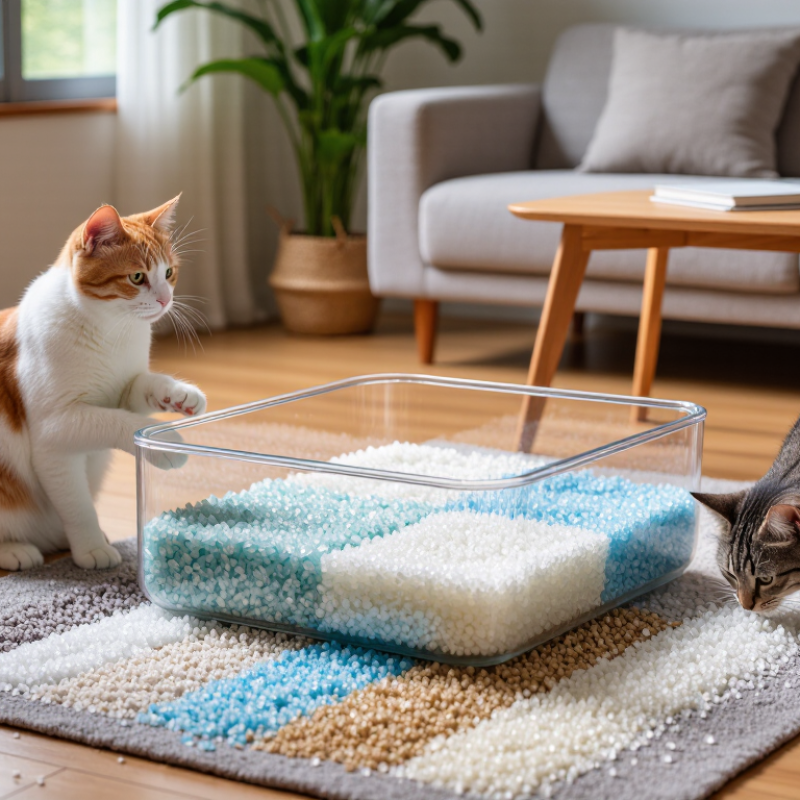
Define Crystal Cat Litter and Its Silica-Gel Absorption Mechanism
How to Choose the Best Crystal Cat Litter?
Crystal cat litter is made from porous, amorphous silica gel, not crystalline quartz. Its beads contain microscopic pores that attract and hold liquid through adsorption and capillary action. Urine spreads across the crystals, while moisture moves into their internal spaces. This leaves the surface comparatively dry. The mechanism is practical, but not magical. Solid waste still needs daily removal, and crystals require gentle stirring for even saturation. The American Pet Products Association’s 2023–2024 National Pet Owners Survey reported about 46.5 million U.S. households owned cats. That scale makes dust control, odor management, and disposal habits important household concerns.
When choosing crystals, inspect particle size, dust levels, and moisture capacity. Larger beads may track less, but some cats dislike their sharp texture. Fine crystals can feel softer, yet they may create more airborne dust. Silica gel is generally different from respirable crystalline silica, a hazardous dust classified by occupational-health authorities. Still, ventilation matters. One overlooked issue is visual judgment: a box can look dry while its pores are already saturated. Replace it according to odor, texture, and manufacturer guidance, not appearance alone.
Tips: Choose unscented crystals for sensitive cats. Place the tray in a ventilated, quiet area. Remove solids every day. Stir carefully. Do not flush used litter unless local wastewater guidance clearly permits it. Watch for coughing, paw irritation, or avoidance; your cat’s behavior may reveal a problem before the litter does.
How to Choose the Best Crystal Cat Litter? - Define Crystal Cat Litter and Its Silica-Gel Absorption Mechanism
| Evaluation Dimension | What Crystal Cat Litter Means | Relevant Facts and Typical Characteristics | What to Look For When Choosing |
|---|---|---|---|
| Definition | A non-clumping litter made from porous silica gel crystals. | Silica gel is a form of amorphous silicon dioxide, commonly produced from sodium silicate. It is not the same as crystalline quartz dust. | Choose clearly labeled silica gel or amorphous silica products with ingredient and safety information. |
| Absorption Mechanism | Liquid is captured inside the pores of the crystals. | Capillary action draws moisture into the porous structure, while the large internal surface area supports physical adsorption of water and some odor molecules. | Prefer crystals with even porosity, good liquid uptake, and low powder content. |
| Urine Handling | Absorbs urine without forming a conventional scoopable clump. | Most of the liquid remains in the litter until the crystals approach their absorption capacity; some moisture may gradually evaporate depending on ventilation and humidity. | Select a product with clear instructions for stirring and full replacement rather than clump removal. |
| Solid Waste Management | Solid feces are removed separately with a litter scoop. | Daily removal of feces helps limit bacterial growth and odor. Crystals contaminated with fecal matter should be removed rather than left in the tray. | Use a scoop with openings that remove solids while retaining clean crystals. |
| Odor Control | Controls odor mainly by removing moisture from urine and trapping some odor compounds. | Odor control decreases as the crystals become saturated. Ammonia odor can develop when urine remains in a damp, overloaded tray. | Choose adequate tray capacity, follow the recommended fill depth, stir regularly, and replace saturated litter promptly. |
| Dust Level | Dust depends on crystal size, manufacturing, transport, and handling. | Larger, well-screened crystals generally release less airborne dust than highly fragmented material, although no litter is completely dust-free. | Look for low-dust claims supported by visible screening quality; pour slowly and avoid shaking the bag. |
| Tracking and Texture | Crystal granules can be carried outside the tray on a cat’s paws. | Fine crystals may track more easily, while large or irregular granules may reduce tracking but can feel less comfortable to some cats. | Balance granule size, softness, and tracking; use a litter mat outside the tray. |
| Scent and Additives | Crystal litter may be unscented or contain added fragrance. | Many cats prefer unscented litter. Added fragrance can mask odor for people but may discourage sensitive cats from using the tray. | Start with unscented litter, especially for cats with respiratory sensitivity or strong scent preferences. |
| Color-Change Indicator | Some products use color-changing crystals as a monitoring aid. | Color changes can indicate moisture, pH-related changes, or saturation, but they are not a veterinary diagnostic test. | Treat color as a cleaning or observation signal, not as proof of a medical condition. |
| Safety and Ingestion | Silica gel is designed to absorb moisture and is generally considered low in acute toxicity when small amounts are accidentally swallowed. | It is not intended to be eaten. Ingestion of large amounts may cause gastrointestinal upset or obstruction, and dust may irritate the eyes or airways. | Keep the package sealed, supervise kittens that eat litter, and contact a veterinarian after significant ingestion or respiratory distress. |
| Moisture and Climate | Performance is affected by how much liquid enters the tray and by environmental humidity. | High humidity can reduce the remaining absorption capacity before use. Wet litter also becomes less effective at controlling odor. | Store in a dry, sealed place and use a larger tray or more frequent changes for multi-cat households. |
| Cleaning Routine | Requires regular solid removal, stirring, and periodic complete replacement. | A typical routine includes removing feces daily, stirring crystals to distribute moisture, and replacing litter when odor or saturation appears. | Choose a litter that matches the household’s cleaning frequency and the number of cats sharing the tray. |
| Best Overall Selection Criteria | The best option is the one that the cat consistently accepts and that the caregiver can maintain correctly. | Prioritize cat acceptance, low dust, suitable granule texture, reliable moisture absorption, manageable odor, transparent ingredients, and practical packaging. | Introduce gradually, monitor litter-box use, and change the product if the cat avoids the tray, shows irritation, or develops unusual toileting behavior. |