Payless Pet Products

Payless Pet ProductsPayless Pet ProductsPayless Pet ProductsPayless Pet Products
  • Home
  • New Website
  • Fish Amoxi Forte 500mg
  • Fish Aug 625mg
  • Fish Cipro Forte
  • Fish Clinda Forte
  • Fish Doxy
  • Fish Fluco Forte
  • Fish Itra
  • Fish Keto
  • Fish Levo 500mg
  • Fish Zithro 250mg
  • Fish Zithro 500mg
  • Fish Zithro 1000mg

Payless Pet Products

Payless Pet ProductsPayless Pet ProductsPayless Pet Products
  • Home
  • New Website
  • Fish Amoxi Forte 500mg
  • Fish Aug 625mg
  • Fish Cipro Forte
  • Fish Clinda Forte
  • Fish Doxy
  • Fish Fluco Forte
  • Fish Itra
  • Fish Keto
  • Fish Levo 500mg
  • Fish Zithro 250mg
  • Fish Zithro 500mg
  • Fish Zithro 1000mg
How to Choose the Right Laser Dielectric Film?

How to Choose the Right Laser Dielectric Film?

Choosing the right Laser Dielectric Film starts with the laser, not the coating catalogue. Wavelength, pulse duration, beam size, angle of incidence, and polarization all affect performance. A mirror that works at 1064 nm under continuous-wave operation may fail under short, intense pulses. Small details matter.

The ISO 21254 series defines methods for measuring laser-induced damage thresholds; it does not guarantee that a coating will survive every real-world setup. SPIE’s Laser Damage conference proceedings likewise document how test conditions and coating design shape damage results. These references help buyers ask better questions: Was the threshold tested at the intended wavelength, pulse duration, and repetition rate? Were the substrate and measurement method comparable? A single damage number is not enough.

H. Angus Macleod, author of Thin-Film Optical Filters, is a foundational authority in coating design. His work supports a practical principle: evaluate the complete layer stack against the application, rather than judging one layer alone. That is a paraphrase, not a direct quotation. Industry market reports, such as Laser Focus World’s annual laser market coverage, provide useful context on laser applications, but they cannot replace application-specific testing. The right choice balances reflectance or transmission, absorption, spectral bandwidth, environmental durability, and production consistency. Ask for test conditions and documented results. Then check them against your actual beam path. That step is easy to overlook.
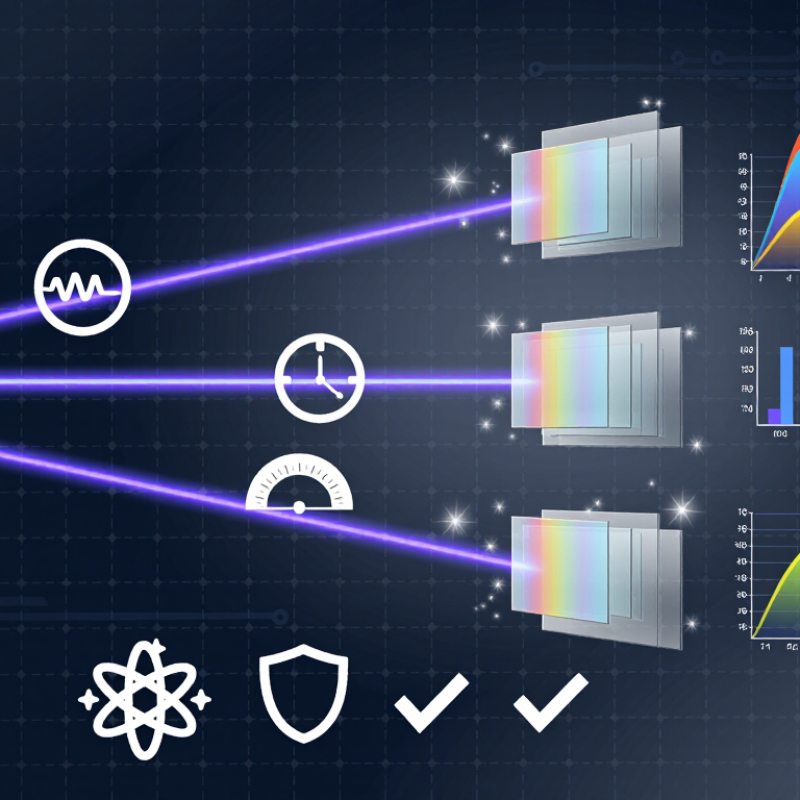
How to Choose the Right Laser Dielectric Film?
Table of Contents [Hide]
1 Define the operating wavelength: 355, 532, or 1064 nm?
2 Match coating design to incidence angle and polarization: 0° or 45°?
3 Set reflectance or transmission targets, such as HR >99.5% or AR <0.5%
4 Compare LIDT in J/cm² at the stated pulse width and repetition rate (ISO 21254)
5 Check substrate, spectral bandwidth, and environmental operating limits

Define the operating wavelength: 355, 532, or 1064 nm?

How to Choose the Right Laser Dielectric Film?
Define the operating wavelength: 355, 532, or 1064 nm?

Start with the laser’s actual operating wavelength, not simply its color label. A 355 nm beam is ultraviolet, 532 nm is green, and 1064 nm is near-infrared. Dielectric films use carefully designed layer stacks, so a coating made for one wavelength may perform poorly at another. Choose a film specified for your wavelength and intended function, such as reflection or transmission. Small shifts matter.

Wavelength alone is not enough. Check the angle of incidence, polarization, and operating bandwidth against your setup. For pulsed lasers, confirm the coating’s damage-threshold data under conditions similar to your pulse duration and beam size. A 355 nm system may need extra attention to cleanliness and material compatibility; contamination can affect performance. It is easy to overlook these details when a specification sheet highlights only the center wavelength.

Tips: Confirm the wavelength at the optic, especially if the system uses tunable output. Ask for performance data at your actual incidence angle, and verify whether the stated range covers temperature or wavelength drift. If your setup changes, revisit the specification. The first choice may not remain the right one.

How to Choose the Right Laser Dielectric Film?

Start by identifying the laser’s operating wavelength: 355, 532, or 1064 nm.

Photon energy is calculated from E = hc/λ. These wavelengths correspond to approximately 3.49 eV, 2.33 eV, and 1.17 eV per photon, respectively. Select a coating designed for the actual operating wavelength; also check the angle of incidence, polarization, bandwidth, and laser-induced damage threshold.

Match coating design to incidence angle and polarization: 0° or 45°?

How to Choose the Right Laser Dielectric Film?

The right coating depends on how the beam meets the optic. At 0° incidence, the beam travels nearly perpendicular to the surface, and polarization usually has little effect. This can simplify the coating design. At 45°, the beam meets the surface obliquely. The coating’s spectral response shifts, while s- and p-polarized light can behave differently. A design that performs well at 0° may miss its target wavelength at 45°. Small differences matter.

Specify the operating wavelength, angle, and polarization before comparing coatings. Also check bandwidth, substrate, and whether the beam has a wide angular spread. For a laser used at 45°, request performance data at that angle for both relevant polarizations. Then compare it with the actual setup, not just a catalog curve. A neat drawing is not enough; real alignment can vary slightly. I’ve seen this detail overlooked. It is easy to assume “45°” is exact.

Tips: Confirm whether the stated angle is measured from the surface normal. Test the optic in its intended orientation, and allow for alignment tolerance. If polarization is uncertain, ask for data covering both s and p states.

How to Choose the Right Laser Dielectric Film? — Match Coating Design to Incidence Angle and Polarization: 0° or 45°?

Design condition Polarization requirement What changes in the coating Recommended design specification What to verify
0° angle of incidence
(near-normal incidence)
Unpolarized, s-polarized, or p-polarized light At normal incidence, s and p polarization have the same response for an isotropic, non-birefringent coating stack. The design is generally less sensitive to polarization than an oblique-incidence design. Specify the operating wavelength, required reflectance or transmittance, bandwidth, substrate, and angle tolerance. State whether the beam is truly normal or has a small angular cone. Measure or calculate performance at the operating wavelength and across the beam’s angle range. Confirm the coating side and substrate orientation.
45° angle of incidence
(fixed-angle use)
Both s and p polarization, or polarization not controlled At oblique incidence, s- and p-polarized light generally experience different reflection and transmission. Interference features also shift with angle; the amount depends on the coating materials and layer design. Design specifically for 45° and request separate s- and p-polarized performance. If both polarizations matter, set requirements for each rather than relying on a single averaged value. Check s and p spectra separately at 45°. Confirm the specified angle is measured from the surface normal and that the test uses the intended surrounding medium.
45° angle of incidence
(polarization-controlled beam)
Known s or p polarization A coating can be optimized for the selected polarization, but its performance for the orthogonal polarization may differ. The relevant polarization is defined relative to the plane of incidence. State the selected polarization, the plane of incidence, the wavelength, and the required reflectance or transmittance. Specify extinction or leakage limits if the other polarization must be suppressed. Verify the coating with the same polarization orientation and incidence geometry as the intended optical setup.
Variable angle or converging/diverging beam Both polarizations or a range of polarization states Different rays encounter the coating at different angles, so spectral response and polarization behavior can vary across the beam. A design optimized at one angle may not meet the target throughout the full cone. Provide the minimum and maximum incidence angles, beam cone or numerical aperture, wavelength range, and polarization requirements. Consider an angularly tolerant design if the application permits. Evaluate performance across the full angle range and for both s and p polarization when applicable, not only at the central ray.
Laser damage-sensitive application
(at 0° or 45°)
As required by the optical system Angle and polarization affect optical performance; laser-induced damage resistance is a separate property and depends on the coating, substrate, wavelength, pulse duration, repetition rate, and test conditions. Specify the laser wavelength, pulse duration, repetition rate, beam size, operating angle, polarization, and applicable damage-test standard or test method. Request damage-threshold data for matching test conditions. Do not compare thresholds measured with different pulse durations, wavelengths, or test methods as if they were equivalent.

Selection rule: Choose 0° when the optical layout allows near-normal incidence and polarization-independent behavior is desirable. Choose a 45° design when the component must operate at 45°, and specify s and p requirements separately unless only one polarization is used. Coating performance is design-specific; confirm it against the actual wavelength, angle, polarization, substrate, and operating conditions.

Set reflectance or transmission targets, such as HR >99.5% or AR <0.5%

When choosing a laser dielectric film, define the optical target before comparing designs. For a high reflector, specify reflectance above 99.5% at the operating wavelength, angle, and polarization. For an antireflection coating, set reflectance below 0.5% across the required wavelength range, not just at one test point. Small differences matter. At 99.5% reflectance, the remaining 0.5% may be transmitted, absorbed, or scattered, depending on the coating and substrate.

Check the conditions. A coating that meets 99.5% at 1064 nm and normal incidence may perform differently at a tilted angle or across a broader laser spectrum. State whether the target applies to s-polarized light, p-polarized light, or both. Also clarify the measurement method and acceptable production variation. I would not treat a single-point number as a complete specification; it is useful, but incomplete. For example, a narrowband target can be practical for a stable laser, while a tuning range may require tighter control across several wavelengths. Include the substrate and operating environment when requesting data, since temperature and surface quality can affect measured performance.

Compare LIDT in J/cm² at the stated pulse width and repetition rate (ISO 21254)

When comparing laser dielectric films, treat the listed LIDT as a test result, not a universal rating. Compare values in J/cm² only when the pulse width and repetition rate match. A threshold measured with 10-nanosecond pulses at 10 Hz may not predict performance with shorter pulses or a faster pulse train. Small details matter.

Check that the wavelength, beam size, and test procedure also align. ISO 21254 describes laser damage testing, but a standard reference alone does not make two results directly comparable. Look for the stated damage criterion, number of test sites, and whether the value is a single-shot or multiple-shot result. If these details are missing, ask for them. A neat table can still hide a mismatch.

In practical selection, compare the film’s tested conditions with the laser’s real operating conditions, including pulse energy and spot size. Repetition rate can affect heat buildup, while pulse width changes how energy interacts with the coating. Leave a safety margin rather than choosing a film exactly at its reported threshold. The margin depends on beam stability, alignment, and operating environment; no single figure fits every setup. Data sheets are sometimes incomplete, so note what remains uncertain before making a decision.

Check substrate, spectral bandwidth, and environmental operating limits

Choosing the right laser dielectric film begins with the substrate. Check whether it is glass, fused silica, or another material, then confirm its surface quality, thermal expansion, and compatibility with the coating process. These details affect adhesion and optical performance. A coating designed for one substrate may not behave the same way on another.

Define the required spectral bandwidth around the actual operating wavelength, not just the laser’s nominal setting. Include the angle of incidence and polarization, since both can shift a coating’s response. A narrowband film may offer strong reflection or transmission near one wavelength, but tolerate little drift. Also check operating limits, including temperature, humidity, vacuum exposure, cleaning methods, and laser fluence. Ask for test conditions and damage-threshold data relevant to your setup; published figures may not match every real installation. Small details matter.

Tips: Share the substrate, wavelength range, beam angle, and expected environment when requesting specifications. I would recheck the operating temperature and cleaning procedure before ordering; those points are easy to overlook, and I have seen them treated as afterthoughts. If conditions vary, discuss a wider usable bandwidth or additional qualification testing.

Article Source:

  • Cosmetic Packaging
  • Discount Cosmetic Packaging

Copyright © 2021 Payless Pet Products - All Rights Reserved.