How to Choose a Planetary Gearbox in 2026?
A planetary gearbox can look compact on a drawing and still run hot, wear early, or miss its positioning target. In 2026, choosing one means matching the unit to the real machine—not just comparing torque ratings. A Gearbox Planetary selection should account for reduction ratio, continuous and peak torque, backlash, input speed, radial loads, duty cycle, mounting position, and available space. Small details matter. A washdown line, a frequent start-stop cycle, or a heavy cantilevered load can change the answer.
Demand for precise motion is growing alongside automation. The International Federation of Robotics reported 541,302 industrial robot installations worldwide in 2023, with 4,281,585 robots in operation. These figures, published in World Robotics 2024, show the scale of equipment that depends on reliable motion components. They do not predict gearbox demand directly. That distinction matters. For an actual application, check the manufacturer’s rating conditions and ask how torque, speed, temperature, and service life were tested. ISO 6336 offers established methods for assessing the load capacity of cylindrical gears, but it does not replace application-specific validation of a complete planetary gearbox.
This guide explains how to compare designs, read specifications, and avoid common sizing mistakes. Look beyond the headline ratio. Check backlash under load, thermal limits, lubrication needs, and bearing capacity. Then confirm the unit fits the motor and mounting arrangement. No selection is perfect. The useful choice is the one whose limits are understood, documented, and acceptable in your operating conditions.
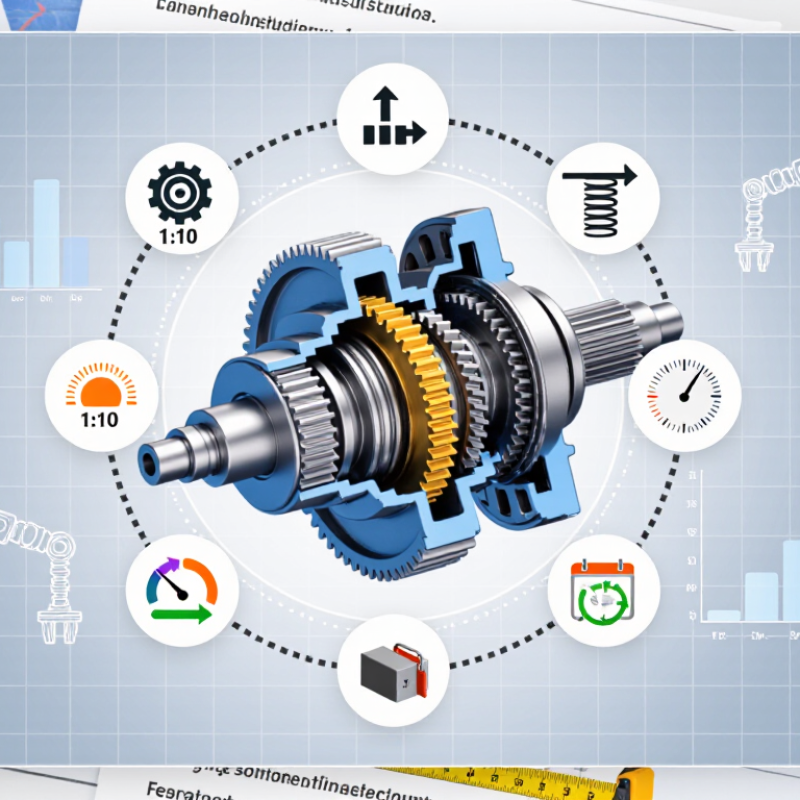
Understand Planetary Gearbox Design and Operating Principles
A planetary gearbox places a sun gear at the center, planet gears around it, and an outer ring gear around them. The carrier holds the planets and transfers rotation to the output. This compact layout shares load across several teeth, but real load sharing depends on alignment, clearances, and manufacturing quality. Small errors matter.
The U.S. Department of Energy’s 2014 motor-systems sourcebook estimates that motor-driven systems use about 68% of U.S. manufacturing electricity. The International Energy Agency’s Energy Efficiency 2023 report also highlights industry’s substantial energy use. These figures make gearbox losses worth checking, though neither report measures planetary gearboxes alone. For selection, match ratio and rated torque to the actual duty cycle, including starts, reversals, and shock loads. Check output speed, backlash, mounting position, bearing loads, lubrication, and heat dissipation. A gearbox may meet its torque rating yet overheat under frequent acceleration. That gets missed. Compare efficiency at the operating speed and load, not only at the catalog’s best point. Leave room for uncertainty: service life depends on installation and maintenance, not just the design sheet.
Planetary Gearbox Selection: Ratio vs. Estimated Output Torque
A simple planetary gearset with the ring gear fixed, sun gear as input, and carrier as output.
Values are calculated examples, not manufacturer ratings. For an 18-tooth sun gear and a 10 N·m input, the ratio is 1 + ring teeth ÷ sun teeth. Estimated output torque assumes 90% gearbox efficiency: output torque ≈ input torque × ratio × efficiency. Actual performance depends on design, load, speed, lubrication, and operating conditions.
Define the Motion, Torque, and Load Requirements
Start with the motion profile, not the gearbox catalogue. Record output speed, acceleration, reversals, dwell time, and positioning accuracy across a full operating cycle.
A conveyor running steadily has different needs from a robot arm that starts, stops, and changes direction repeatedly.
The International Federation of Robotics reported 4.28 million industrial robots operating worldwide in 2023 in World Robotics 2024. That scale makes repeatable motion requirements worth defining carefully.
Next, calculate continuous and peak torque separately.
Include the driven load’s inertia, friction, gravity, and any shock during starting or stopping. A gearbox may handle a brief peak yet overheat under repeated peaks. This is easy to miss.
The U.S. Department of Energy’s 2002 Industrial Electric Motor Systems Market Opportunities Assessment estimated that motor-driven systems used about 68% of U.S. manufacturing electricity. Though dated, the figure underscores why operating conditions matter: unnecessary oversizing can add cost and energy demand.
Compare the required torque and speed with the gearbox’s rating at the actual duty cycle, not just a headline maximum. Check shaft loads and mounting orientation, too. Measurements are rarely perfect; validate assumptions with real cycle data before final selection.
Compare Gear Ratios, Efficiency, Backlash, and Service Life
A planetary gearbox ratio sets the trade-off between output speed and torque. A higher reduction generally lowers speed and increases available torque, but losses matter. Match the ratio to the motor’s actual operating range, not just its peak rating. Check the required output speed under load, too.
Efficiency changes with ratio, load, lubrication, and temperature. Compare data measured near your operating point rather than relying on one headline figure. A warm gearbox after a short test may be normal; a steadily rising housing temperature deserves attention. Small details count. Record the load and duty cycle before choosing.
Backlash matters most in positioning tasks. Check how it is specified and measured, especially at the output shaft. A low backlash figure can improve repeatability, but it may raise cost or limit available options. Service life depends on more than rated torque: shock loads, mounting, lubrication, and starts per hour all play a part. I would not treat a catalog life estimate as a guarantee. Real duty is often less tidy than the test conditions. A unit can meet the torque requirement on paper and still wear early if heat or load cycles were underestimated.
How to Choose a Planetary Gearbox in 2026? — Compare Gear Ratios, Efficiency, Backlash, and Service Life | Selection Factor | Typical Values or Options | What to Consider | Practical Selection Guidance |
| Gear ratio and stages | One stage: approximately 3:1–10:1
Two stages: approximately 10:1–100:1
Three stages: approximately 100:1–1,000:1 | Higher ratios usually require more stages. The available range varies by gearbox design and product series. | Calculate the ratio from motor speed and required output speed. Choose the lowest practical number of stages when compactness, efficiency, and low backlash matter. |
| Efficiency | Typical planetary-stage efficiency: about 95%–98%
Indicative overall efficiency at 95%–98% per stage:
One stage: 95%–98%; two stages: 90%–96%; three stages: 86%–94% | Efficiency depends on design, load, speed, lubrication, temperature, and operating conditions. Overall multi-stage efficiency is approximately the product of each stage’s efficiency. | Compare efficiency at the intended speed and load, rather than relying only on a headline maximum. Include gearbox losses when sizing the motor and estimating heat. |
| Backlash | Standard: often about 10–20 arcmin
Precision: often about 3–8 arcmin
Low-backlash designs: often about 1–3 arcmin | Backlash is angular lost motion when the direction of torque reverses. Published values and measurement conditions differ between designs. | Use lower-backlash options for positioning, indexing, and frequent reversals. Check the specified value at the gearbox output and confirm whether it is a maximum or typical value. |
| Torque and load capacity | Compare rated continuous torque, permissible peak torque, emergency-stop torque, and radial and axial load limits. | Peak torque ratings generally apply for limited durations or specific duty conditions; they should not be treated as continuous ratings. | Size for the actual duty cycle, acceleration, shock loads, and external forces. Verify that both continuous and peak loads remain within the supplier’s stated limits. |
| Service life | No single service-life value applies to all planetary gearboxes. Life is specified or estimated for a particular model and operating profile. | Load, speed, temperature, lubrication, contamination, mounting, and shock loading all affect service life. | Request a life estimate for the application’s actual load and duty cycle. Confirm the assumptions, maintenance requirements, and any stated life-rating method. |
| Operating speed and heat | Check permitted input speed, output speed, continuous operating limits, and thermal capacity for the selected ratio. | Higher speed and sustained loading can increase heat and lubricant stress. Limits vary by gearbox size and configuration. | Verify the operating point against the model’s speed and thermal ratings, especially for continuous-duty applications or restricted cooling. |
| Lubrication and maintenance | Depending on the design, gearboxes may be supplied lubricated for life or require specified inspection or lubricant service. | Lubricant type, orientation, temperature, sealing, and service interval are model-specific. | Follow the gearbox manufacturer’s instructions for mounting position, lubrication, and maintenance. Consider access and downtime requirements during selection. |
Note: The figures above are representative selection ranges, not guaranteed specifications. Confirm ratio availability, efficiency, backlash, torque limits, and service-life estimates for the exact gearbox model and application.
Assess Materials, Lubrication, Mounting, and Operating Conditions
For a planetary gearbox, material choice should match the load, environment, and expected service life. Hardened steel gears suit repeated high torque, while lighter housings can help reduce moving mass. Check bearing and seal materials too; moisture, dust, or cleaning chemicals may affect their durability. Small details matter.
Lubrication is not a minor specification. Grease can simplify maintenance in some low-speed applications, while oil may better carry heat away under sustained loads. Follow the gearbox maker’s guidance for lubricant type, fill level, and service intervals. Too much lubricant can also create heat. Check operating temperature, shaft speed, and orientation before deciding; the same lubricant may behave differently across conditions.
Mounting needs equal care. Confirm that the chosen flange or foot pattern fits the machine, and keep input and output shafts aligned. Poor alignment can increase noise, vibration, and bearing wear. Then assess the real operating cycle: startup frequency, shock loads, daily running hours, ambient temperature, and exposure to contaminants. A gearbox rated for average torque may still struggle with repeated peaks. Leave a reasonable service factor, but avoid sizing by guesswork alone. Record actual loads where possible. Estimates are sometimes wrong. Compare them with the manufacturer’s ratings and installation instructions before final selection.
Verify Compatibility, Supplier Specifications, and Total Cost of Ownership
How to Choose a Planetary Gearbox in 2026?
Verify Compatibility, Supplier Specifications, and Total Cost of Ownership
Start with the machine, not the catalog. Record the required ratio, peak and continuous torque, input speed, duty cycle, and available mounting space. Check shaft dimensions, orientation, and allowable radial and axial loads against the gearbox drawings. A unit may fit the frame yet fail under repeated acceleration. Small details matter. Leave a margin for shock loads, but avoid oversizing without a reason; extra capacity can increase purchase cost and inertia.
Tips: Ask suppliers for rated torque curves, backlash limits, thermal data, and test conditions. Compare like with like. Verify that the specifications apply to your speed and operating cycle, not just an ideal test setup. Measure twice. If a tolerance or service-life estimate is unclear, request it in writing before approval.
Compare total ownership cost, not just the quoted price. Include installation, lubrication, expected maintenance, energy losses, replacement intervals, and the cost of production downtime. Check warranty terms, spare-part availability, delivery time, and technical support response. A lower-cost gearbox can become expensive if it needs frequent adjustment or delays a repair. Estimates are never perfect; review your assumptions with maintenance staff and update them using actual operating data after installation.