A Fish Tank Filter is more than a plastic box moving water. It is the aquarium’s quiet life-support system, handling waste, suspended particles, and water circulation. Inside, mechanical media catches debris, while biological media supports bacteria that process toxic ammonia and nitrite. Some filters also use activated carbon or other chemical media. Each method has a different purpose.
Industry data shows why this equipment matters. The American Pet Products Association’s 2023–2024 National Pet Owners Survey reported millions of U.S. households keeping freshwater fish, confirming steady demand for practical aquarium care. Grand View Research has also identified aquarium equipment as a growing segment within the wider pet-care market. However, market forecasts vary. They should guide planning, not replace water testing.
Cory McElroy, founder of Aquarium Co-Op, offers a useful warning: “A filter is not a replacement for water changes.” That sentence deserves attention. A strong current cannot remove every dissolved pollutant. Nor can expensive media correct overfeeding, overcrowding, or neglected maintenance. A filter only works well when its flow matches the tank, fish, plants, and media design.
This guide explains how filtration works in real conditions, from water entering the intake tube to returning through the outlet. You will see why filter flow ratings can mislead, why beneficial bacteria need oxygen, and why rinsing media under tap water can damage an established biofilter. Small details matter. Mistakes happen. Understanding the process helps aquarists choose equipment with greater confidence, cleaner water, and healthier fish.
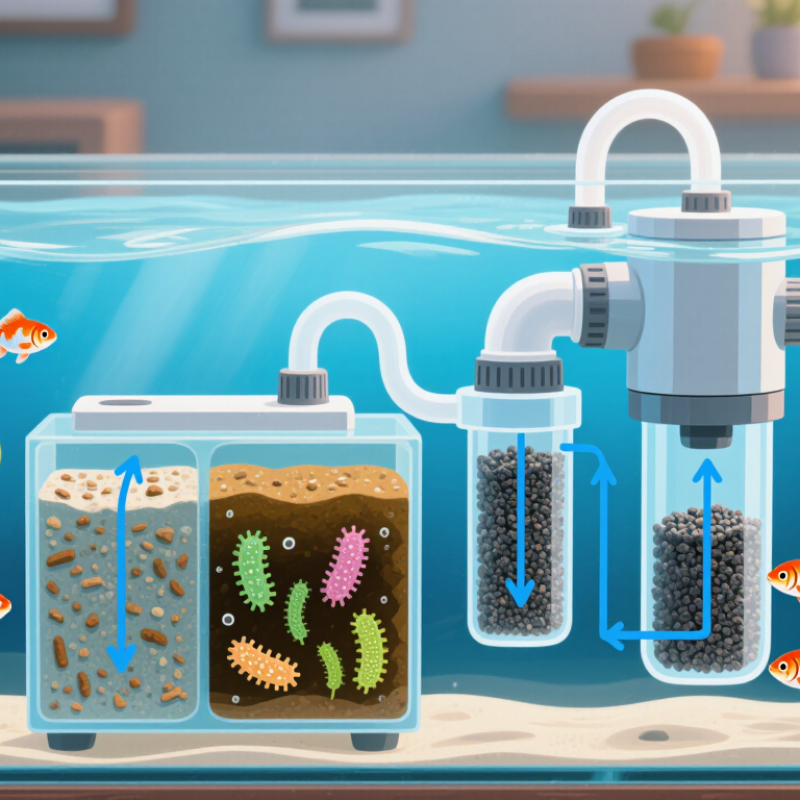
What Is a Fish Tank Filter and How Does It Work?
A fish tank filter is a device that moves aquarium water through several cleaning stages. Its main job is to remove waste, support beneficial bacteria, and improve water circulation. Most filters contain a motor, an intake tube, and filter media. The motor pulls water from the tank. Cleaned water then returns through an outlet.
The first stage usually catches visible debris, such as uneaten food, plant pieces, and fish waste. This is mechanical filtration. Another stage provides space for beneficial bacteria. These bacteria help process toxic ammonia and nitrite produced by fish waste. Biological filtration is especially important because clear water can still be chemically unsafe. A filter may also use chemical media for odors or discoloration, but this is not always necessary.
Water movement matters too. Gentle circulation spreads oxygen and prevents stagnant corners. However, a strong current can exhaust slow-swimming fish or disturb gravel. I once cleaned filter media too thoroughly, and the tank became cloudy afterward. That mistake removed useful bacteria. Now, I rinse media gently in removed aquarium water, never directly under treated tap water. That is safer.
A filter does not replace regular water changes. It also cannot correct overcrowding, overfeeding, or poor maintenance. Check the flow each week. A blocked intake often makes the filter sound unusually loud. The water may look fine. The tank may not be fine.
What Is a Fish Tank Filter and How Does It Work?
A fish tank filter is a small water-cleaning system with several working parts. The intake tube pulls water from the aquarium into the filter housing. A strainer blocks larger debris, such as uneaten food or loose plant leaves. Inside, an impeller spins on a motor shaft and pushes water through the unit. This moving part may sound quiet, but it controls the whole flow.
The main parts are the filter media, housing, motor, impeller, and outlet. Mechanical media, usually a sponge or pad, catches visible particles. Biological media provides surfaces for helpful bacteria that process fish waste. Some filters also contain chemical media, which can remove selected odors or discoloration. The outlet then returns filtered water to the tank, creating gentle movement near the surface. In practical use, uneven flow often means a clogged sponge, trapped air, or a dirty impeller. The layout is not always intuitive. I still occasionally overlook the impeller well.
Tips: Rinse reusable media in removed aquarium water, not tap water, to protect beneficial bacteria. Check the intake strainer weekly. Keep the outlet slightly above or below the surface, depending on the desired water movement. Replace media only when damaged or exhausted. Changing everything at once can disturb the tank’s biological balance. Watch the fish, too; hiding, gasping, or unusual swimming may show that flow or water quality needs attention.
A fish tank filter moves water in a continuous loop. An intake tube draws water from the tank, often near the bottom where waste settles. A pump then pushes this water through mechanical media, such as foam or fine floss. These layers catch uneaten food, plant debris, and suspended particles. The water may look clearer, but clarity alone proves little.
Next, water reaches biological media with many small pores. Beneficial bacteria grow there and convert toxic ammonia into nitrite, then less harmful nitrate. This process needs oxygen-rich flow, not merely fast movement. FAO Technical Paper 451, Recirculation Aquaculture Systems, explains that effective biofiltration depends on steady water circulation and sufficient oxygen transfer. The 2024 FAO report recorded 94.4 million tonnes of aquatic animals from aquaculture in 2022, showing why dependable water treatment matters at scale.
Water finally returns through an outlet or spray bar. Its direction should disturb the surface gently. Surface movement helps exchange gases, while excessive turbulence can stress fish or uproot plants. A useful household reference is four to six tank turnovers per hour, though this is not a universal rule. Fish size, stocking density, filter media, and maintenance change the real requirement. I have seen clear water hide clogged media and weak flow. That mistake is easy to repeat.
The filter is not a waste disposal system. It is a living treatment pathway. Clean the mechanical media regularly, but rinse biological media with removed tank water. Tap-water disinfectants can damage the bacterial community.
A fish tank filter is a small water-treatment system. It pulls water through media and returns it to the aquarium. The pump creates movement, but filtration does more than remove visible debris. The American Pet Products Association’s 2023–2024 National Pet Owners Survey estimates that 11.1 million U.S. households keep freshwater fish. That makes filter knowledge practical, not optional.
Mechanical filtration catches solid waste, uneaten food, and loose plant material. Foam, floss, or mesh performs this first task. Rinse it carefully in removed tank water, not chlorinated tap water. Biological filtration supports bacteria that convert toxic ammonia into nitrite, then nitrate. This is the living core of the system. The Merck Veterinary Manual identifies ammonia and nitrite as major aquarium health hazards. Chemical filtration uses media such as activated carbon to reduce odors and some dissolved compounds. It is useful, but not always necessary.
These three methods often share one filter chamber. Water quality depends on contact time, oxygen, and steady flow. U.S. Environmental Protection Agency water-quality guidance recognizes pH and temperature as factors affecting ammonia toxicity. Over-cleaning can damage biological colonies. I have seen clear water hide unstable chemistry. That is the awkward lesson: appearance is not proof of safety. Test ammonia, nitrite, nitrate, and pH before changing media. A filter can be powerful, yet poorly maintained.
| Filtration Type | Primary Function | How It Works | Common Filter Media | Main Benefits | Limitations | Maintenance Considerations | Typical Aquarium Uses |
|---|---|---|---|---|---|---|---|
| Mechanical Filtration | Removes visible and suspended particles from the water. | Water passes through material with small openings that trap uneaten food, fish waste, plant debris, and other solid particles. | Filter floss, sponge, foam, filter pads, and filter socks. | Improves water clarity and reduces the amount of solid waste circulating through the aquarium. | Does not remove dissolved toxins or complete the nitrogen cycle by itself. | Rinse reusable media in removed aquarium water to avoid damaging beneficial bacteria. Replace disposable media when it becomes clogged or deteriorated. | Useful in freshwater, marine, planted, breeding, and heavily stocked aquariums. |
| Biological Filtration | Processes toxic nitrogen compounds produced by fish waste and decomposing organic matter. | Beneficial microorganisms colonize porous media. They convert ammonia into nitrite and then convert nitrite into nitrate through nitrification. | Biological sponges, ceramic media, sintered glass, porous rock, and other high-surface-area materials. | Provides continuous biological support and is essential for maintaining a stable nitrogen cycle. | Requires time to establish. Chlorinated water, certain medications, over-cleaning, or prolonged lack of oxygenated flow can reduce the bacterial population. | Keep the media wet and oxygenated. Clean it gently in removed tank water rather than untreated tap water, and avoid replacing all biological media at once. | Important for virtually all established aquariums, including freshwater and marine systems. |
| Chemical Filtration | Removes or alters selected dissolved substances in the water. | Specialized media adsorb, bind, or chemically exchange unwanted compounds as water flows through them. | Activated carbon, phosphate-removing media, ammonia-binding media, and ion-exchange resins. | Can help remove odors, discoloration, some dissolved organic compounds, or specific nutrients when appropriately selected. | Media are selective and temporary. Some products can remove beneficial substances or interfere with medications; chemical media do not replace regular water changes or biological filtration. | Follow the media's replacement instructions and monitor the parameter it is intended to control. Remove chemical media when it is unsuitable for a treatment or livestock requirement. | Useful for targeted water-quality problems, odor control, post-treatment cleanup, or specialized aquarium conditions. |
| Combined Filtration | Provides mechanical, biological, and optional chemical filtration in one water-flow system. | A pump moves aquarium water through several stages, commonly trapping solids first, supporting beneficial bacteria second, and using chemical media only when needed. | Layered sponge or floss, biological media, and a removable chemical-media compartment. | Offers broad water-treatment capability and makes it easier to adapt filtration to stocking levels and aquarium conditions. | Requires correct media order and regular servicing. Excessive cleaning or unnecessary chemical media can reduce effectiveness. | Keep mechanical media accessible for frequent cleaning, preserve mature biological media, and treat chemical media as optional and purpose-specific. | Suitable for community aquariums and systems where stable water quality and clear water are both priorities. |
What Is a Fish Tank Filter and How Does It Work?
Choosing a fish tank filter starts with water volume, stocking level, and fish behavior. A filter should move the full tank volume several times per hour, but the label’s rate is often measured without media or dirt. A practical target is four to six turnovers hourly. Strong flow can stress slow swimmers. Watch the fish, not only the specification.
Biological media supports bacteria that convert toxic ammonia into nitrite, then nitrate. The U.S. EPA’s 2013 freshwater ammonia criteria show that toxicity changes with temperature and pH. At 25°C and pH 8.0, about 5.4% of total ammonia is un-ionized and more toxic. Test ammonia and nitrite weekly, especially after adding fish. Replace cloudy mechanical media when water flow drops, but do not replace all biological media at once. Rinse it in removed aquarium water. Tap water may damage the bacterial colony. I once treated “clear water” as healthy water; that was a poor assumption. Clear water can still contain dangerous ammonia. Merck Veterinary Manual also emphasizes stable filtration and regular water-quality testing for captive fish. Clean the impeller and intake monthly. Check the filter after every power outage. A quiet filter is not always a working filter.
A common starting point is to circulate the aquarium’s full water volume about 4–6 times per hour. The ranges shown are calculated from that guideline and represent nominal pump flow before losses caused by filter media, tubing, water depth, and buildup. Choose a filter that provides suitable biological and mechanical filtration without creating excessive current for the fish.
Copyright © 2021 Payless Pet Products - All Rights Reserved.