For global buyers, choosing an Outdoor Trampoline is not just a price comparison. Frame steel, weld consistency, spring coverage, enclosure mesh, and replacement-part availability all affect long-term value. A polished product photo cannot show whether the frame joints stay firm after repeated assembly. Ask for clear specifications, inspection records, warranty terms, and practical guidance for setup and care.
Dr. David Schwebel, an injury-prevention researcher whose work includes trampoline-related injuries, offers a useful research-based perspective. The following is a paraphrase, not a verbatim quotation: “Buyers should consider safety features and use guidance alongside cost.” That distinction matters. A trustworthy supplier should explain what its product is designed to do, and what it is not designed to do.
This guide will help compare China-based manufacturers through concrete checks: materials, construction details, quality-control practices, communication, and after-sales support. Look closely at small things. Are the spring pads evenly stitched? Do the instructions show each assembly step? Can the supplier identify replacement components without vague promises? These details are easy to overlook. I would also question any claim that sounds perfect; product quality can vary between models and production batches. A careful shortlist, supported by verifiable documents and direct questions, gives buyers a more grounded starting point.
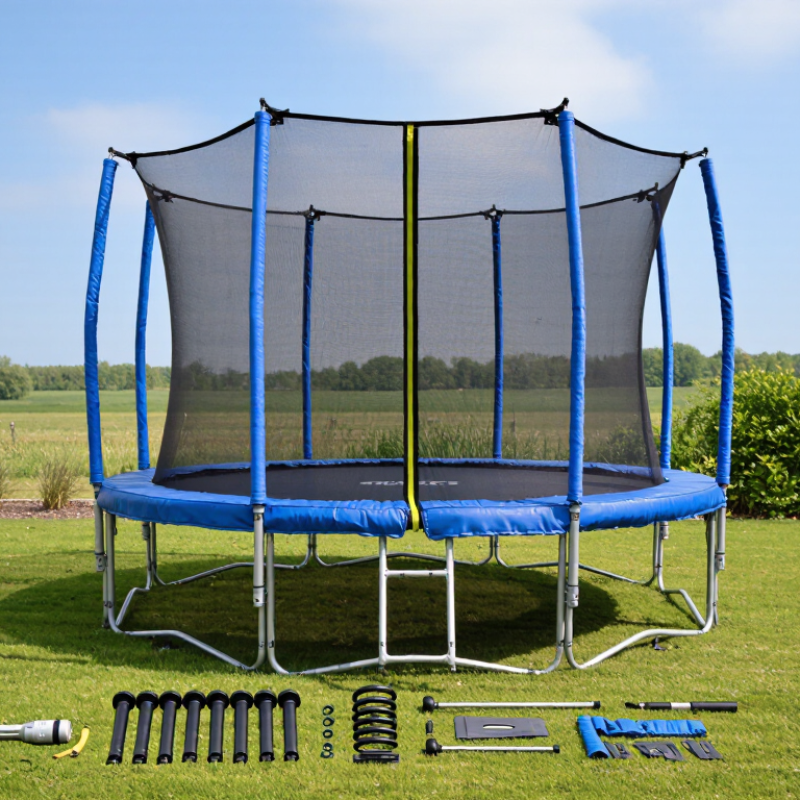
Outdoor trampoline sourcing covers three distinct formats: round, rectangular, and in-ground models. Grand View Research’s 2024 Trampoline Market report estimates the global market at about US$3.2 billion in 2023, with projected growth through 2030. This figure covers more than outdoor units, so it should not be treated as a direct measure of demand for each shape. Fit matters. Round models often suit family gardens, where a centered jumping area and safety enclosure are practical. Rectangular designs use space differently and can support more controlled bounce patterns, but they need careful frame and spring specifications.
In-ground models sit closer to the lawn, creating a less prominent profile. They also require excavation, reliable drainage, and access for inspection. Wet soil can complicate installation. Buyers comparing manufacturers should request frame dimensions, net and pad materials, load-test details, replacement-part availability, and installation guidance. ASTM International’s trampoline safety standards offer useful technical reference points, but buyers should confirm which standard and test scope apply to the specific product. No shape is automatically best. Yard size, intended users, local ground conditions, and maintenance capacity all affect the decision. A product sheet alone may not reveal those trade-offs.
For global buyers, ASTM F381 and EN 71-14 offer useful safety benchmarks for domestic trampolines. ASTM F381 addresses consumer trampoline components, assembly, use, and labeling. EN 71-14 sets requirements and test methods for domestic trampolines. Their scopes are not identical. Check the edition, intended age group, and destination-market requirements before comparing test reports.
The risk is measurable. The U.S. Consumer Product Safety Commission’s 2014 NEISS estimate recorded 104,691 trampoline-related injuries treated in U.S. emergency departments. That figure does not identify the cause of each injury, but it shows why design details matter. Inspect frame joints, spring coverage, net attachment points, and warning labels. Ask whether test documents cover the exact model and configuration—not just a similar product. A passed test cannot promise zero injuries.
Tips: Request full, model-specific reports against the applicable standard. Check that the enclosure stays taut and that padding covers every exposed spring. Then review the instructions yourself; unclear wording is easy to overlook, and worth questioning.
Outdoor trampoline performance begins with the frame, not its paint. Ask factories for the steel grade, tube diameter, wall thickness, and corrosion-protection process. These details help buyers compare frames beyond appearance. For outdoor use, inspect coating coverage around welds, joints, and drilled holes, where moisture can collect. Details matter. Request close-up production photos and a sample inspection record; a polished catalogue image proves little.
Spring design affects both bounce and long-term wear. Spring length, wire thickness, quantity, and placement should work together with the mat size and frame geometry. Uneven spacing can create inconsistent tension, even when the spring count looks impressive. Ask how the factory checks spring tension and attachment points during assembly. A sample unit can reveal sharp edges or uneven stitching, but one sample cannot represent every production run.
Load ratings need careful reading. Confirm whether a stated limit applies to one user, total user weight, or a static test. Ask for the test method, tested model, and supporting records, then compare them with the exact frame and spring configuration you plan to order. Ratings are easy to print and harder to interpret. Some supplier sheets omit test conditions; buyers should treat that gap as a question, not as reassurance.
For global buyers comparing outdoor trampoline manufacturers in China, an ISO 9001:2015 certificate is a useful starting point, not proof that every trampoline is safe. ISO’s 2022 Survey recorded more than 1.2 million valid ISO 9001 certificates worldwide. The figure shows how widely the system is used; it does not verify a specific product or factory. Ask for the certificate’s scope, issuing body, validity dates, and audited production site. Check that the address matches the factory making your order.
Product testing should match the trampoline’s design and market. Ask for reports identifying the tested model, sample size, test date, and applicable methods. ASTM F381 covers consumer trampoline components, assembly, and use; ASTM F2225 addresses trampoline enclosures. Review results for frame stability, spring attachment, mat strength, and net seams. The paperwork must match the model being purchased. A similar-looking sample is not enough.
A factory audit should include the production floor, not just a conference room. Inspect weld consistency, spring counts, incoming-material records, and how rejected parts are separated. Request batch traceability and evidence that corrective actions were closed. No audit is perfect. Even a careful visit can miss a weak process on a busy shift, so compare audit findings with recent test reports and production records before approving an order.
Recommended evidence points for reviewing ISO 9001:2015 certification, product testing, and factory audits. This is a buyer checklist, not a rating of any supplier.
Review 3 ISO items: certificate validity, site and scope coverage, and certification-body accreditation. Review 4 product-testing items: applicable test requirements, laboratory report, model match, and sample traceability. Review 4 factory-audit items: production controls, quality records, equipment calibration, and corrective-action records. ISO 9001 certifies a quality-management system, not a trampoline product.
For outdoor trampolines, MOQ often depends on frame size, mesh specifications, packaging, and custom colors. Ask suppliers to quote both standard and customized options; the difference can reveal whether a high MOQ reflects production setup or simply sales preference. Request a sample, packing dimensions, and a written production schedule before confirming an order. Lead time should separate manufacturing, inspection, and inland transport. It is easy to underestimate the last part. UNCTAD’s Review of Maritime Transport 2024 notes that over 80% of world merchandise trade by volume moves by sea, so port congestion and vessel schedules can affect delivery dates.
Incoterms 2020 clarify delivery responsibilities, costs, and risk transfer, but they do not set product quality or payment terms. For containerized shipments, compare FCA with FOB carefully; FCA is often more suitable when goods are handed to a carrier before loading onto a vessel. DAP generally leaves import clearance and duties to the buyer, while DDP assigns these to the seller, subject to practical import capabilities. Put the named place or port directly in the contract. “FOB China” is too vague.
Tips: Ask for MOQ, production days, inspection timing, and the exact Incoterm named place in one dated quotation. Keep a buffer for port delays. Even a good estimate can slip.
| Supplier Profile | Typical Outdoor Product Range | Indicative MOQ | Sample Lead Time | Bulk Production Lead Time | Common Incoterms 2020 Options | Buyer Checks |
|---|---|---|---|---|---|---|
| OEM factory focused on family-size round trampolines | 8–15 ft round models; galvanized steel frames, jumping mats, springs, safety enclosures, and weather-resistant padding | 100–300 units per model or configuration | 7–15 days for a standard sample; longer if tooling or custom colors are required | 30–45 days after deposit, final specifications, and packaging artwork approval | FOB for sea shipments; FCA for nominated-carrier handover | Confirm frame-wall thickness, spring count and dimensions, net attachment, carton drop-test requirements, and destination-market safety requirements. |
| OEM factory specializing in rectangular sports and training models | Rectangular trampolines for home recreation or training; reinforced frame options and higher spring counts may be available | 50–150 units per model, depending on size and specification | 10–20 days for a configured sample | 35–55 days after specifications and order details are confirmed | FCA or FOB; CIF may be quoted for sea freight | Request load and durability test information for the exact model; verify intended use, user-weight limits, and spare-parts availability. |
| Factory producing compact outdoor models for smaller gardens | 6–10 ft round trampolines; compact frames, enclosure systems, and retail-ready packaging | 200–500 units per model; mixed-container orders may be negotiable | 7–14 days for an existing design | 25–40 days for repeat or standard orders; custom packaging can add time | FOB or FCA; DAP may be available through a freight provider | Check packed dimensions and gross weight, because these affect container loading and landed cost; confirm whether accessories are included. |
| Factory offering customized colors and private-label packaging | Round or rectangular outdoor models with configurable mat, pad, net, and carton artwork | 300–800 units per design or color; custom components may require higher minimums | 15–25 days, including artwork and sample approval | 40–60 days after artwork, materials, and production sample are approved | FCA or FOB; CIF subject to route and carrier availability | Approve a signed sample and color references; clarify ownership of custom artwork, packaging requirements, and inspection criteria. |
| Factory with export packing and accessory-kit capability | Outdoor trampoline sets bundled with ladders, anchors, covers, or replacement parts | 100–300 sets per configuration; accessory-only MOQ may differ | 10–18 days, depending on accessory availability | 30–50 days after the bill of materials is finalized | FOB for ocean freight; DAP or DDP may be quoted for suitable destinations | Confirm accessory quantities, installation instructions, packaging contents, and who handles destination import clearance, duties, and taxes. |
Important: Figures are indicative sourcing ranges, not verified quotations or commitments from specific manufacturers. MOQ and lead time vary by model, order volume, season, customization, material availability, and inspection requirements. Confirm all terms in the purchase contract. Under Incoterms® 2020, FOB applies only to sea or inland-waterway transport; under FCA, the seller clears the goods for export; under CIF, the seller pays freight and specified insurance to the named destination port, while risk transfers when goods are on board the vessel. Under DAP, the buyer generally handles import clearance and duties; under DDP, the seller is responsible for import clearance and applicable duties, where legally and practically possible. Always state the named place or port and “Incoterms® 2020” in the order.
Copyright © 2021 Payless Pet Products - All Rights Reserved.