Choosing an Undermount Kitchen Sink supplier in China involves more than comparing prices and product photos. The sink sits beneath the countertop, so precise dimensions, rim construction, and installation guidance matter. A small mismatch can complicate fitting or leave an uneven edge. Details matter.
China has suppliers with different capabilities, from standard stainless-steel models to customized designs and varied finishes. Buyers should compare material specifications, steel thickness, bowl depth, drainage layout, and documented quality checks. Ask for dimensioned drawings, sample availability, packaging details, and clear lead-time estimates. These practical records make comparisons more reliable than broad claims in a catalog. Still, documents cannot replace careful product review.
This guide introduces leading suppliers and explains how to assess their products, communication, and manufacturing support. It also considers questions worth asking before requesting a quotation, such as how a supplier handles custom dimensions or reports inspection results. A factory visit or independent inspection may help when order value and project needs justify the extra effort. That takes time.
Supplier rankings should be treated as a starting point, not a guarantee of fit. A company suited to a large hospitality project may not serve a small renovation well. Verify current specifications directly, and confirm that sink dimensions match the chosen countertop and cabinet plan. Even a thorough checklist can miss something. The final choice depends on the project, the evidence available, and how carefully details are confirmed.
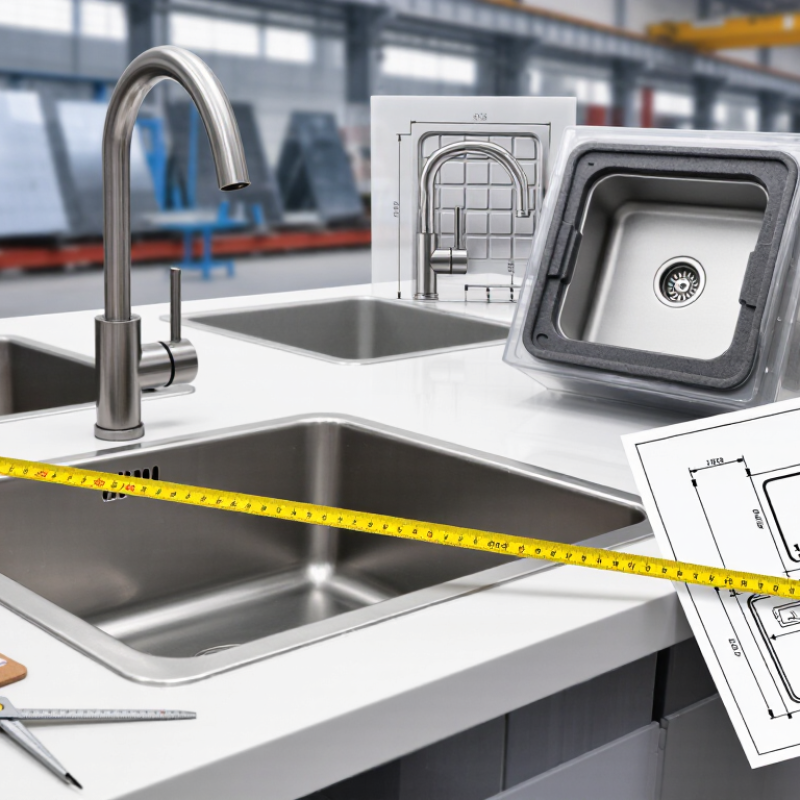
An undermount kitchen sink sits below the countertop, leaving a clean edge and an uninterrupted surface for wiping crumbs into the basin. Its installation depends on more than appearance. The countertop must support the sink, and the cabinet needs enough room for the bowl, plumbing, and mounting hardware. Stone and solid-surface counters are common choices, but the right installation method depends on the material and sink design. Details matter.
China’s supplier market includes factories with different strengths, from stainless-steel fabrication to sink-and-accessory production. Buyers should compare steel grade, bowl depth, corner radius, finish, and drain position rather than relying on product photos alone. A brushed sample can reveal uneven grain or sharp edges. Ask for material specifications, dimensional drawings, packaging details, and inspection records before confirming an order. One sample is useful, but it may not represent every production run.
Clear communication is practical quality control. Confirm whether cutout dimensions refer to the sink or the countertop, and agree on acceptable surface marks in writing. Request photos of a packed unit and check how the supplier handles replacement parts. I have seen specifications look complete while small details remain unclear. That part is easy to overlook. A careful review cannot remove every risk, but it can expose mismatched expectations before goods leave the factory.
A practical material comparison for evaluating undermount sink options from Chinese suppliers.
Approximate reference densities: 304 stainless steel, 8.0 g/cm³; cast iron, 7.2 g/cm³; quartz composite, 2.6 g/cm³; and fireclay, 2.4 g/cm³. Composite and ceramic formulations vary, and density alone does not indicate sink quality or durability.
Top Undermount Kitchen Sink Suppliers in China
Key Criteria for Evaluating Undermount Sink Suppliers
When comparing undermount sink suppliers, check more than the surface finish. Ask for the stainless steel grade, sheet thickness, bowl depth, and corner radius. These details affect durability, noise, cleaning, and cabinet fit. Request a technical drawing showing the rim, drain position, and mounting points. A few millimeters can matter when the countertop opening is already cut. It is easy to overlook this.
Review how the supplier controls quality across production, not just on one sample. Ask whether each batch is checked for dimensions, weld consistency, surface marks, and drainage. A polished sample may not represent every production run, so request inspection records or a pre-shipment check. Confirm how the sink is protected in transit; the rim and corners need firm packaging. Also clarify order quantities, lead times, replacement parts, and response times. Vague answers are worth noting.
Tips: Compare samples under the same lighting, then inspect the underside and drain area. Pour water into the bowl and look for pooling. Keep the drawing, approved sample details, and written specifications aligned. If a requirement seems unclear, ask again before production begins. Better to be slightly fussy now.
Leading Undermount Kitchen Sink Suppliers in China
China’s stainless-steel supply base gives undermount sink buyers considerable manufacturing depth. World Stainless Association data put China’s 2023 stainless-steel production at about 36.7 million tonnes, out of 58.4 million tonnes worldwide. That scale supports access to sheet material, pressing, welding, and finishing expertise. It does not guarantee a well-made sink.
Leading suppliers should provide clear specifications, not just polished product photos. Ask for steel grade, gauge, bowl dimensions, corner radius, sound-dampening details, and installation clearances. A sample can reveal rough welds, uneven brushing, or sharp edges around the drain. Check whether the supplier can share inspection records and explain how it tests for leaks and dimensional consistency. Small details matter.
Look beyond the quotation. Confirm packaging protects the rim, because a dent can complicate a flush countertop installation. Request a production sample and compare it with the approved drawing. Be candid: a smooth sample does not prove every unit will match. Factory audits and repeat inspections add confidence, but they also take time. Buyers should weigh those costs against order size, delivery schedules, and the consequences of rework. A reliable supplier answers specific questions in writing and flags limitations early.
An undermount sink’s lifespan depends on its steel, forming, and finishing—not just its polished surface. Grade 304 stainless steel typically contains about 18% chromium and 8% nickel, while grade 201 uses less nickel. World Stainless Association reported 58.4 million tonnes of global stainless-steel production in 2023. That figure shows the material’s scale, not the quality of any individual sink. Ask Chinese suppliers for the stated grade and a mill test certificate. Details matter.
Manufacturers commonly press a steel blank into shape, then trim, weld, grind, and polish it. Poorly finished corners can collect grime; uneven mounting rims may complicate installation. ASTM A240/A240M specifies composition and properties for stainless-steel sheet and strip, but it is not a sink-specific performance approval. Ask how the supplier checks weld leakage, thickness consistency, surface defects, and drainage. A good inspection record should name the test method and acceptance criteria. A neat sample is not enough.
Tips: Request a cutaway sample to inspect steel thickness and sound-dampening pads. Confirm whether the stated thickness applies before or after forming. It is easy to overlook that difference. Ask for inspection records from the same production batch, not only a general certificate.
A useful supplier comparison starts with a clear specification, not a low unit price. List the basin’s length, width, depth, corner radius, steel thickness, and drain position. Details matter. Ask whether quoted dimensions describe the outer rim or the usable bowl. Confirm the steel grade, finish, sound-dampening pads, and overflow configuration in writing. Request a sample or detailed drawings before approving a production run. Check how each supplier inspects surface scratches, welds, and dimensional tolerances. A polished sample is helpful, but it cannot show how consistently a factory handles a large order.
Compare quotations on equal terms. Include packaging, tooling, inspection, delivery schedule, and shipping arrangements. Ask for photographs of export cartons and clear confirmation of what replacement parts or remedies are available for transit damage. A common planning mistake is approving a sink before checking the countertop cutout and cabinet clearance. Measure the cabinet, faucet reach, and drain plumbing with the installer. Even a careful spreadsheet can miss a small fit issue. Build time for sample review, drawing approval, and production checks into the schedule; supplier lead times may change during busy periods. Keep key decisions in one written specification, and record any revisions with dates.
Copyright © 2021 Payless Pet Products - All Rights Reserved.