What Is the Best Type of Bicycle Socks for Wholesale?
Choosing the best Bicycle Socks for wholesale requires more than comparing factory prices. Buyers must examine fiber quality, knitting density, sizing accuracy, and production consistency. A low price can hide weak cuffs, rough seams, or colors that fade after several washes. These details become obvious on a store shelf and during a long ride.
Phil Burt, a respected cycling physiotherapist and apparel consultant, expresses the central principle clearly: “Comfort is performance.” For wholesale buyers, that comfort should come from practical construction. A summer model may need breathable polyester, nylon reinforcement, and a light mesh panel. A winter option may require merino wool, thermal insulation, and a taller cuff. Cushioning under the heel and forefoot can also improve daily riding comfort. Small details matter.
The best supplier should provide samples before large production. Check stretch recovery, moisture management, seam placement, and wash durability. Compare several sizes on different feet. One sample is not enough. It can mislead.
Wholesale decisions also depend on market position. Custom branding, recycled fibers, color matching, packaging, and minimum order quantities affect the final margin. Buyers should request test reports and clear production specifications. Reliable communication matters when thousands of pairs must match one approved sample. Still, no material wins in every climate or price segment. Merino may feel premium, yet it can increase cost and require careful care. Synthetic blends may offer stronger margins, but some riders dislike their hand feel. This is where buyers must reflect, test, and choose honestly. A successful Bicycle Socks program balances rider comfort, supplier reliability, visual appeal, and repeatable wholesale value.
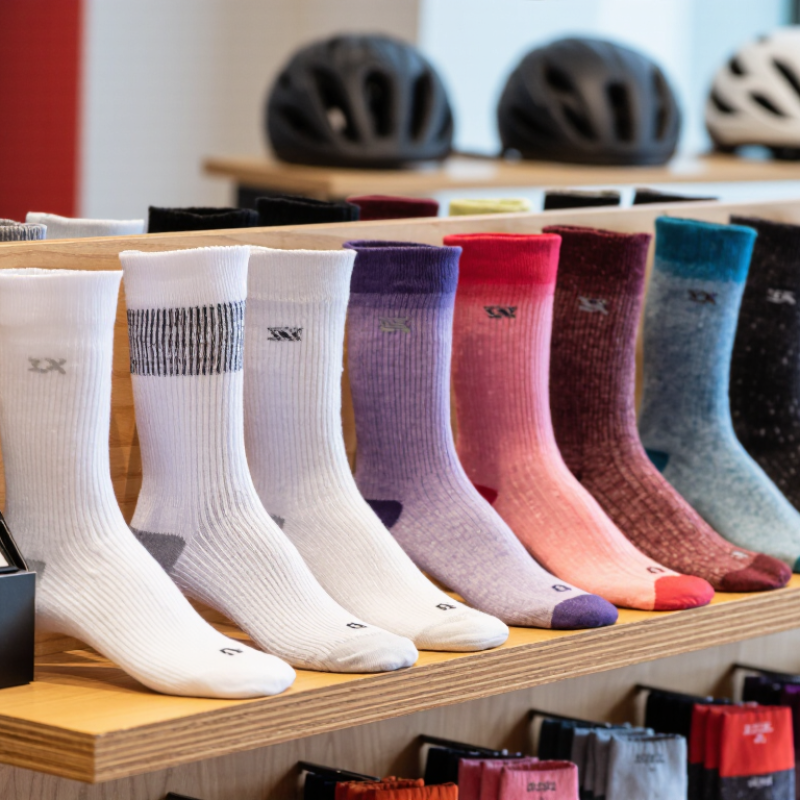
What Makes a Bicycle Sock Suitable for Wholesale?
What Is the Best Type of Bicycle Socks for Wholesale?
What Makes a Bicycle Sock Suitable for Wholesale?
A wholesale bicycle sock must perform consistently across many production batches. For riders, moisture control, quick drying, and secure fit matter during long summer rides. A breathable nylon blend with a small amount of elastane usually offers useful stretch and shape retention. Merino blends can improve warmth, but they may raise costs and require more careful washing guidance.
Fit is equally important. A reliable sock should stay above the ankle without cutting into the calf. A flat toe seam helps reduce rubbing inside cycling shoes. Light compression around the arch can improve stability, although excessive tightness may discourage repeat purchases. Test several sizes with real riders. A sample that feels perfect on a desk may slip after two hours of pedaling.
Wholesale suitability also depends on production control. Suppliers should provide clear size charts, fabric percentages, color references, and repeat-order tolerances. Inspecting random cartons can reveal loose threads, uneven cuffs, or mismatched colors before shipment. Packaging should protect the socks without adding unnecessary bulk. Flexible minimum order quantities help smaller retailers test demand, while stable lead times support seasonal planning. I have seen buyers focus too heavily on unit price and overlook return costs. That decision often becomes expensive. No specification is perfect for every market, so feedback from actual riders should influence the next production run.
What Is the Best Type of Bicycle Socks for Wholesale? - What Makes a Bicycle Sock Suitable for Wholesale?
| Product Dimension | Recommended Specification | Why It Suits Cycling Use | Wholesale Consideration |
|---|---|---|---|
| Primary Fabric | Moisture-managing blend Polyester or polyamide combined with elastane | Man-made performance fibers generally dry faster than cotton and help move perspiration away from the skin. Elastane provides stretch and recovery. | Offers broad consumer appeal, consistent sizing, and practical performance for road, commuting, indoor, and recreational cycling. |
| Cotton Content | Low or moderate cotton content for lifestyle-focused models; avoid relying on cotton for highly athletic styles | Cotton feels soft but absorbs moisture and dries slowly, which can leave feet damp during extended or intensive rides. | A mixed range can serve both performance buyers and casual customers without making every style highly technical. |
| Elastane Level | Approximately 2–8% elastane, depending on the knitting method and design | Provides a secure fit, reduces sagging, and helps the sock remain comfortable as the foot moves inside the shoe. | Good stretch recovery reduces complaints related to loose cuffs and improves repeat-purchase potential. |
| Sock Height | Crew or mid-calf height, commonly reaching several inches above the ankle | Provides coverage from shoe edges, road debris, and sunlight while matching the appearance preferred by many cyclists. | Mid-calf styles are versatile and easier to merchandise across cycling, fitness, and outdoor categories. |
| Cuff Construction | Elastic ribbed cuff with a secure but non-restrictive hold | Keeps the sock in place without excessive pressure. A smooth or covered elastic can improve comfort during long rides. | Stable cuffs reduce returns caused by slipping, while neutral cuff designs work across a wider range of customers. |
| Arch Support | Light to moderate knitted compression band | Helps the sock fit closely around the midfoot and limits bunching inside cycling shoes. | Provides a visible performance feature without requiring complex components or significantly increasing production difficulty. |
| Toe Seam | Flat-linked or low-profile toe seam | Reduces friction and pressure points where the toes contact the front of a cycling shoe. | Improves perceived quality and is a useful specification for product descriptions and quality-control checks. |
| Cushioning | Light cushioning under the heel and forefoot; optional full-cushion styles | Provides comfort and impact absorption while preserving a close fit inside snug cycling footwear. | Light cushioning is the most versatile option. Separate cushion levels can create a simple product range. |
| Ventilation | Mesh-knit panels on the top of the foot and breathable knit zones | Open-knit areas can improve airflow and help heat and moisture escape during warm-weather riding. | Ventilation is easy to communicate visually and can differentiate performance styles without changing the basic sock shape. |
| Heel and Toe Reinforcement | Denser knit or reinforced yarn at high-wear areas | The heel and toe experience repeated friction from footwear and walking, so reinforcement can extend service life. | Improves durability and lowers the risk of early wear-related complaints when supported by consistent inspection. |
| Fit Range | Clearly graded sizes with a unisex fit option where appropriate | Accurate grading helps prevent excessive stretching, tightness, and fabric bunching inside the shoe. | A practical size range reduces inventory gaps and makes size assortment planning easier for wholesale buyers. |
| Color and Pattern | Core neutral colors plus a controlled selection of seasonal patterns | Neutral colors coordinate easily with cycling kits, while patterns allow customers to express personal style. | Balanced assortments reduce overdependence on short-lived trends and help retailers manage sell-through. |
| Care Performance | Machine-washable construction with stable color and shape retention | Cycling socks are frequently washed because they are exposed to perspiration, road dust, and outdoor conditions. | Easy care increases customer satisfaction and supports repeat purchasing when the product maintains its fit. |
| Quality-Control Points | Check measurements, cuff recovery, seam smoothness, fabric density, colorfastness, and pair matching | These checks address the features most likely to affect comfort, appearance, durability, and consistency. | Documented inspection standards help maintain uniformity across production lots and simplify wholesale approval. |
| Packaging and Labeling | Compact recyclable packaging with fiber content, care instructions, size, and country-of-origin information | Clear information helps customers select and care for the product correctly while reducing unnecessary packaging volume. | Efficient packaging lowers storage and transport requirements and supports straightforward retail display. |
The most versatile wholesale option is generally a mid-calf bicycle sock made from a moisture-managing stretch blend, with a secure cuff, arch support, breathable zones, a low-profile toe seam, and reinforced heel and toe areas.